Video Overview
Somaliland's Status: State Continuity vs. Dissolution
Two competing narratives dominate discussions about Somaliland's legal status: the state continuity position argues that Somaliland never legally entered a valid union with Somalia in 1960, making the 1991 declaration a restoration of prior statehood; while the dissolution narrative frames it as a unilateral dissolution of the union. This analysis examines which position is closer to historical facts, has greater global impact, enjoys stronger scholarly support, and which Somaliland should strategically pursue for international recognition.
Which position is closer to historical and legal facts?
The position held by Somaliland advocates; that the territory never legally entered a binding union with Somalia in 1960, making the 1991 declaration a restoration of prior statehood and continuity rather than dissolution; is closer to the historical and legal facts.1
Historical records show that British Somaliland gained independence on 26 June 1960, and started a union process with the former Italian Somaliland (independent on 1 July 1960). The incomplete process was driven by pan-Somali nationalism and decolonisation pressures.11 Indeed, the union was legally defective: Somaliland's legislature passed the "Union of Somaliland and Somalia Law" on 27 June 1960, but Somalia's assembly approved a different version ("Atto di Unione") "in principle" without signing the northern law, rendering it invalid in the south.17
A unified Act of Union was enacted retroactively in January 1961, but this lacked proper ratification and violated international treaty norms requiring mutual consent and identical terms.24 A 1961 constitutional referendum further exposed the flaws, with low turnout in Somaliland (under 17% participation) and over 60% rejection amongst voters there, indicating no popular mandate.39
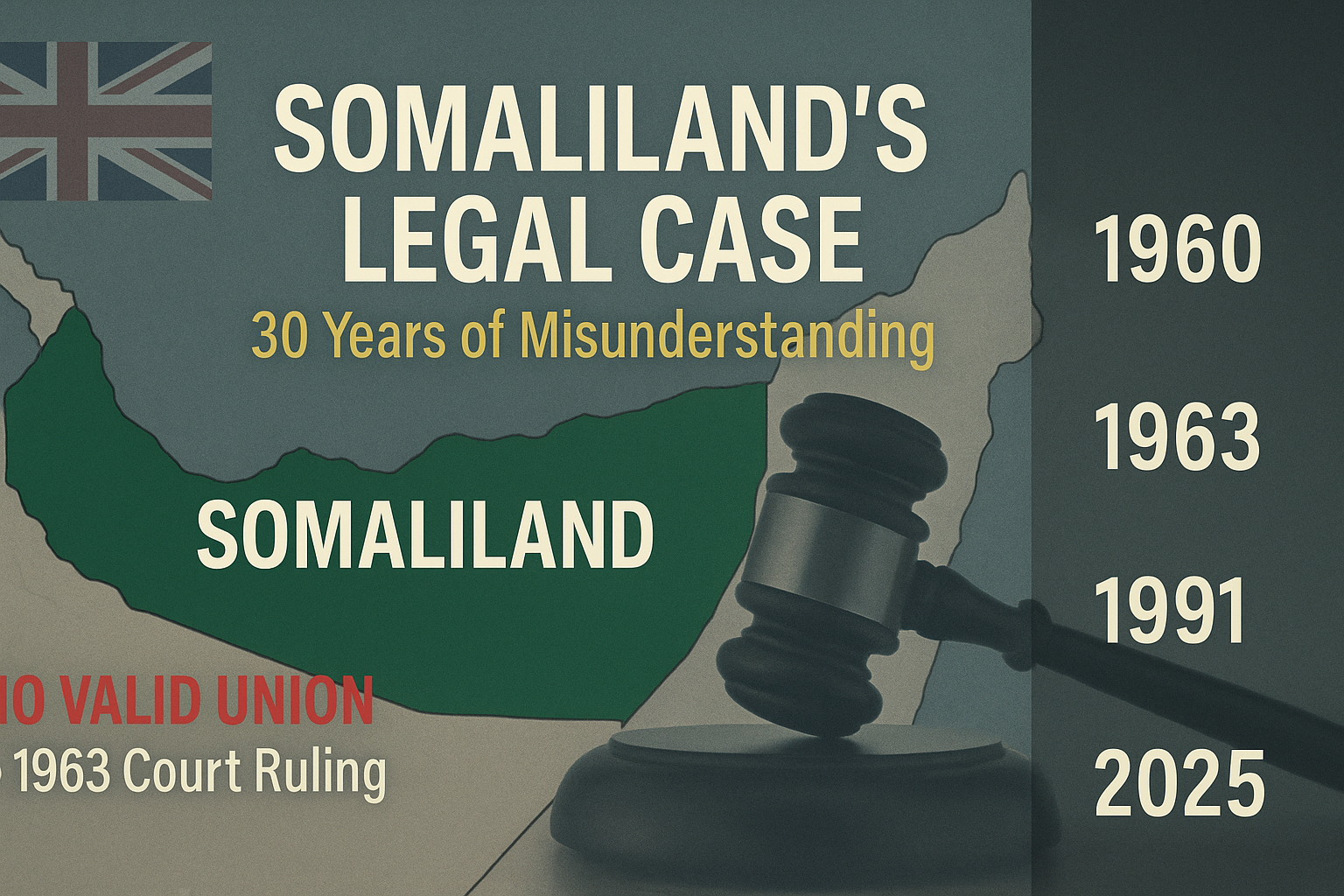
Most significantly, a 1963 Somali Supreme Court ruling acquitted northern coup plotters on grounds that no valid union existed, with the British judge explicitly stating that Somalia lacked jurisdiction over Somaliland officers.27 This judicial determination remains legally significant as it established that the purported union was invalid from its inception.
By 1991, amid Somalia's state collapse and genocidal repression under Siad Barre (including targeted killings of the Isaaq clan, estimated at 50,000–200,000 deaths),29,30 Somaliland's declaration reverted to its pre-1960 borders, framing it as restoration of sovereignty rather than unilateral dissolution from a cohesive state.9
This aligns with international law principles like the Montevideo Convention (requiring population, territory, government, and relational capacity),44 which Somaliland meets through its stable governance and defined colonial-era boundaries.2 In contrast, the simplification as "dissolution in 1991" overlooks these defects and treats the union as irrevocable, which is more a political assertion by Somalia's government than a factual one.9
Territorial Integrity: Misunderstood and Misapplied
The concept of territorial integrity has been fundamentally misunderstood and misapplied in Somaliland's case, creating a false legal barrier to recognition. This misunderstanding stems from conflating different principles of international law and ignoring crucial precedents that clarify the doctrine's actual scope and application.
The Kosovo Precedent and ICJ Clarification
The International Court of Justice's advisory opinion on Kosovo's declaration of independence provides crucial clarification on territorial integrity that directly applies to Somaliland's case. When Serbia challenged Kosovo's independence at the ICJ, arguing that recognising states were violating Serbia's territorial integrity, the Court made several definitive rulings that reshape our understanding of this principle.
The ICJ determined that territorial integrity, as enshrined in the UN Charter, applies specifically to relations between UN member states and prohibits "the threat or use of force against the territorial integrity or political independence of any state."22 Critically, the Court clarified that this principle addresses external threats; one country threatening or using force against another country's territory, or supporting secessionists within another state's borders.
Territorial integrity does not prohibit internal secession itself. The ICJ found that secession and achieving de facto independence through internal processes is permissible under international law. What international law prohibits is external interference; Country A threatening Country B or supporting separatists within Country B's territory.
Application to Somaliland's Case
This clarification directly addresses the primary objection to Somaliland's recognition. When the United States or any other country recognises Somaliland, they are not violating Somalia's territorial integrity because:
- No external force is being used: Recognition does not involve sending troops, providing weapons, or threatening Somalia militarily
- No external support for secession: Somaliland achieved its current status through internal processes following Somalia's state collapse
- The principle doesn't apply to internal developments: As the ICJ confirmed, territorial integrity governs state-to-state relations, not internal political changes
The absurdity of the current position becomes clear when examined practically: how can recognising an already existing sovereign state constitute a threat to use force against Somalia? The territorial integrity argument would only apply if, for example, the US were providing military support to create or maintain Somaliland's separation; which is manifestly not the case.
The Balkanisation Fear and Its Flaws
The primary reason for non-recognition is not legal principle but political fear; specifically, the concern that recognising Somaliland would encourage other secessionist movements across Africa, leading to "Balkanisation." This fear, whilst understandable, is based on several flawed assumptions:
1. False Precedent Concerns: Critics worry that recognising Somaliland would create a precedent for movements like Biafra, Western Sahara, or potential secessionists in Ethiopia. However, this fear ignores the unique legal circumstances of Somaliland's case; particularly the invalid union and pre-existing statehood.
2. Legal vs. Political Distinction: The ICJ's Kosovo ruling established that secession through internal processes is legally permissible. The real question is not whether secession is allowed (it is), but whether specific cases meet the criteria for legitimate statehood under international law.
3. Temporal Misunderstanding: The fear treats all separatist movements as equivalent, ignoring crucial differences in legal foundation, historical context, and international law compliance.
The Lithuanian Precedent: Restoration vs. Creation
A particularly relevant precedent is Lithuania's case following the Soviet Union's collapse in 1991. When Lithuania declared independence, the United States and other nations did not recognise this as new independence or secession. Instead, they recognised the restoration of Lithuania's pre-existing independence that had been illegally terminated by Soviet occupation.
The US explicitly stated that Lithuania's legal personality had never been lost during the Soviet period; it had merely been occupied and annexed illegally. This recognition did not violate anyone's territorial integrity because it acknowledged pre-existing rights rather than creating new ones.
Somaliland's case follows an identical pattern:
- Pre-existing independence (1960)
- Illegal union or occupation (1960-1991)
- Restoration of legal personality (1991)
- Maintenance of sovereign independence (1991-present)
Strategic Implications for Recognition
Understanding territorial integrity correctly transforms the recognition debate. Rather than being a legal barrier, territorial integrity principles actually support Somaliland's recognition when properly applied:
1. No External Threat: Recognising Somaliland involves no threat or use of force against Somalia, making territorial integrity irrelevant.
2. Internal Legitimacy: Somaliland's 30-year maintenance of sovereign independence through internal support demonstrates the kind of organic political development that international law permits.
3. Legal Continuity: Recognition would acknowledge pre-existing legal rights rather than create new territorial arrangements.
4. Precedent Management: Emphasising restoration rather than secession distinguishes Somaliland from movements that lack similar legal foundations.
Countries considering recognition should understand that the territorial integrity objection is based on a misreading of international law that has been clarified by the ICJ. The Kosovo precedent establishes that internal secession followed by recognition does not violate territorial integrity. Somaliland's case is even stronger because it involves restoration of pre-existing statehood rather than creation of new political entities.
The continued misapplication of territorial integrity principles serves political rather than legal purposes, maintaining an unjust status quo that contradicts established international law. Recognition of Somaliland would actually clarify and properly apply territorial integrity principles rather than violate them.
The Colonial Borders Principle: Somaliland's Strongest Legal Foundation
A critical point often overlooked in discussions of Somaliland's recognition is that the African Union's most fundamental principle is not territorial integrity per se, but rather the preservation of colonial borders through uti possidetis juris. This principle, enshrined in the OAU Charter of 1963 and maintained by its successor, the African Union, holds that African states shall respect the borders existing at the time of independence.22
Somaliland's case is uniquely strong under this principle for several reasons:
Perfect colonial border alignment: Somaliland's claimed territory corresponds exactly to the borders of the former British Somaliland Protectorate as established by treaties between Britain and Somaliland clans in 1884 and subsequent boundary agreements.15
Pre-OAU independence: Crucially, Somaliland achieved independence on 26 June 1960, three years before the OAU was established in 1963. This means Somaliland's statehood predates the very organisation whose principles supposedly prevent its recognition.
Recognition precedent: Somaliland was recognised as an independent state by at least 35 countries upon its independence in 1960, establishing its legal personality before any pan-African framework existed to constrain recognition.2
The irony is profound: while the AU cites respect for colonial borders as justification for non-recognition, Somaliland's restoration actually upholds this principle by reverting to the exact colonial boundaries that the OAU was designed to protect. Somalia's territorial claims over Somaliland, by contrast, represent an attempt to maintain borders that resulted from a legally invalid union; precisely the kind of post-independence territorial arrangement that uti possidetis was designed to prevent.
The 2005 AU fact-finding mission implicitly recognised this contradiction, noting that Somaliland's case was unique and that "the union between Somaliland and Somalia was never ratified."22 The mission's reluctance to recommend recognition stemmed not from legal principles, but from political concerns about precedent; concerns that the colonial borders argument actually addresses.
Which has greater global impact?
The simplification that Somaliland dissolved from the union in 1991 has had greater global impact. This narrative dominates international discourse, media coverage, and diplomacy, framing Somaliland as a breakaway region threatening Somalia's territorial integrity and the African Union's adherence to uti possidetis.22
However, this framing fundamentally misunderstands the AU's colonial borders principle. The dissolution narrative has reinforced non-recognition by the UN, AU, and major powers, limiting Somaliland's access to aid, loans, and formal ties, whilst bolstering Somalia's claims despite its instability.23 The continuity argument, whilst factually robust, remains niche amongst scholars and advocates, with limited sway in broader geopolitics where simplicity favours the dissolution label.40
The misapplication of the territorial integrity principle has created a paradox: the AU refuses to recognise Somaliland whilst simultaneously violating its own core principle of respecting colonial borders by treating the invalid 1960 union as legally binding.
Which is supported by stronger references?
The continuity position is supported by significantly stronger references, drawing from rigorous legal scholarship, historical documents, and neutral bodies. These include the landmark 1963 Somali Supreme Court ruling that explicitly found no valid union existed,27 the 2005 AU fact-finding mission that noted the union's non-ratification and Somaliland's unique case,22 and peer-reviewed analyses from institutions like American University Washington College of Law2 and Lewis & Clark Law School.3
Additional support comes from historical documentation of the defective union process, including US State Department records showing the hasty and legally problematic nature of the merger,11 and analysis of treaty law violations in the union formation.17
The dissolution simplification relies primarily on political statements from Somalia's government and AU reluctance, with weaker legal backing. Some analyses even conclude that whilst Somaliland may lack grounds for dissolution under strict legal norms, it clearly qualifies for recognition through restoration of pre-existing statehood.7
Which position should Somaliland pursue to advance its recognition, and why?
The evidence overwhelmingly supports the state continuity position as both legally accurate and strategically superior. Somaliland's path to recognition lies not in arguing for new rights, but in asserting old ones; the restoration of a sovereignty that was never legally surrendered and borders that perfectly align with the AU's own foundational principles.
The colonial borders argument represents Somaliland's strongest legal foundation and should be the centrepiece of its diplomatic strategy. Rather than challenging African unity, Somaliland's recognition would actually vindicate the AU's core principle whilst correcting a historical injustice that has persisted for over six decades.
The time has come for the international community to recognise what the legal evidence has always shown: Somaliland is not seeking to create something new, but to restore something that was illegally taken away.
References
Academic Papers & Legal Documents
1. Legal Problems Arising out of the Formation of the Somali Republic - JSTOR
2. The Case for the Independent Statehood of Somaliland - American University International Law Review
3. Somaliland's Struggle for Statehood - Lewis & Clark Law School
4. Somalia and Somaliland: Ruminations on an Interim Settlement - Macalester College Digital Commons
5. Between Statehood and Somalia: Reflections of Somaliland Statehood - Washington University Open Scholarship
6. Somaliland and the Case for Justified Secession - University of Minnesota Law School
7. Dissolution of union between british and italian somalia - ASP Journals
Government & Official Sources
9. The Republic of Somaliland's Position on the Somaliland - Somalia Talks - Somaliland Ministry of Foreign Affairs
10. The Government of the Republic of Somaliland reiterates its self-determination - Somaliland Ministry of Foreign Affairs
11. Foreign Relations of the United States, 1958–1960, Africa, Volume XIV - US State Department Historical Documents
13. Resource Information Center: Somalia - USCIS
14. Danish Parliament Document - Folketinget
Legal Research & Analysis Sites
15. Somaliland's Union and Disunion and the Lessons of the Scotland Referendum - Somaliland Law
16. Constitutional Developments - Somaliland Law
17. Somaliland & Somalia: The Act of Union - Somaliland Law
18. Somaliland Supreme Court - Somaliland Law
19. Researching the Somaliland Legal System - NYU Law Global
20. Constitutional History of Somalia - ConstitutionNet
Think Tanks & Policy Organisations
21. Somaliland – A Walk on Thin Ice - Konrad-Adenauer-Stiftung
22. Somaliland: Time for African Union Leadership - International Crisis Group
23. Somaliland: scrambled by international law? - Cambridge University Press
Human Rights & Genocide Documentation
28. "Hostages to Peace": Threats to Human Rights and Democracy in Somaliland - Human Rights Watch
29. Isaaq genocide - Wikipedia
30. In the Valley of Death: Somaliland's Forgotten Genocide - Pulitzer Center
31. Somalia Genocide and Famine Warning - Genocide Watch
32. Somalia (Isaaq genocide) - Yale MacMillan Center
33. Genocide in the Horn of Africa - Washington Post
34. Somalia, A Government At War with Its Own People - Human Rights Watch
35. Why Somalis Flee: Synthesis of Accounts of Conflict Experience in Northern Somalia by Somali Refugees, Displaced Persons and Others - Center for Justice & Accountability
Reference & Information Sites
36. Somaliland vs Somalia - Republic of Somaliland
37. Somaliland's Forgotten Genocide - Republic of Somaliland
38. Case for Recognition - Somaliland Mission to the US
39. Somaliland Constitutional Referendum - Participedia
40. Somali Republic - Wikipedia
41. Portal:Somaliland/Selected article/16 - Wikipedia
42. Declaration of Statehood by Somaliland and the Effects of Non-Recognition - Scientific Research Publishing
43. Somaliland and the Need to Update International Law on Statehood Recognition - Michigan Journal of International Law
International Law Documents
44. Montevideo Convention on the Rights and Duties of States - ILSA
45. Somalia Constitution 1960 - Citizenship Rights in Africa Initiative
Social Media & Forums
46. Ministry of Foreign Affairs - Somaliland Facebook Post - Facebook
47. Somaliland & Somalia: The 1960 Act of Union - Facebook Group
48. Why did Siad Barre hate Isaaqs so much? - Reddit
Database & Archive Sources
49. Somaliland: shackled to a failed state - Gale Academic Database
This reference list contains sources related to the legal analyses of the 1960 union between Somaliland and Somalia, constitutional issues, statehood recognition, and related historical documentation.