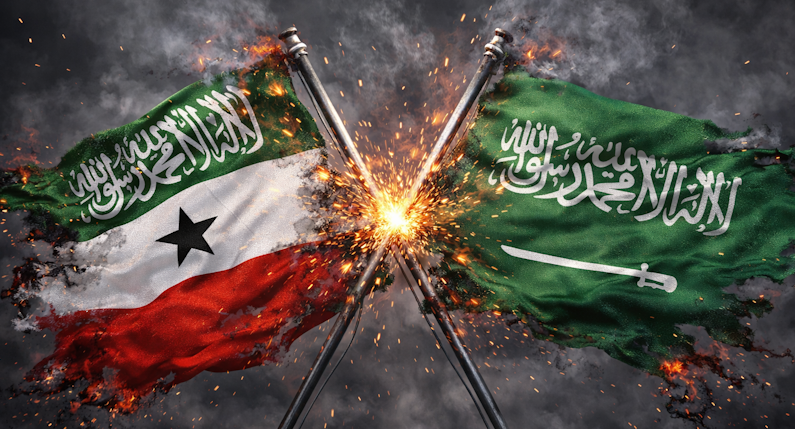
When a country that has existed for more than thirty years still triggers panic in Saudi Arabia by being recognised, the real issue is not Somaliland. It is Saudi Arabia.
A confident middle power does not feel threatened by diplomatic labels. A secure regional actor does not respond to symbolic recognition with boycotts, proxy pressure, and political escalation. Riyadh’s response exposes insecurity, not strength. It is as if Somaliland seceded from Saudi Arabia.
Saudis are acting shocked, but deep down they are aware of their own delusions. The biggest lie is not that Somalia and Somaliland are one country. The bigger lie is this: Somalis are Arabs. Somalis are not Arabs in any meaningful social or political sense. The claim of Arab identity is instrumental, not organic. Somalia’s membership in the Arab League was never about shared political culture or collective democratic aspiration. It was a strategic posture, largely designed to counter Ethiopia.
This is why Somaliland’s democracy, like its assertion of sovereignty, does not resonate across the Arab world as precedent or inspiration. It is viewed as external, peripheral, and ultimately irrelevant to Arab political identity. Neither Somalia nor Somaliland is ever expected to influence an Arab state politically or diplomatically. For example, Somaliland’s political developments do not inspire Arabs. If they did, Somaliland’s repeated democratic elections would have triggered an Arab Spring years ago. They did not.
The legal debate around secession remains a distraction. Even if Somaliland were framed as a secessionist case, it does not inspire Arab state fragmentation, just as South Sudan did not. No Arab state is at risk because of Somaliland. The anxiety being projected is artificial.
The real driver is geopolitical control combined with identity politics.
Saudi Arabia is recalibrating after losing strategic alignment with the UAE and is now attempting to appease Turkey and Egypt. All three share an interest in preserving a regional order where emerging non-Arab, non-Turkic actors do not mature into independent middle powers.
Without UAE guidance, however, Saudi Arabia’s poor judgment has become increasingly exposed. Saudi pressure has already backfired. Orders issued through Mogadishu to expel the UAE presence were intended to isolate Somaliland. Instead, Puntland and Jubaland rejected them outright, exposing Somalia, not Somaliland, as structurally divided. The episode damaged Saudi Arabia’s international standing beyond its controlled domestic narrative.
Again without the UAE, Saudi Arabia’s headless chicken diplomacy is visible not only in Somaliland but also in its approach to Iran. Narrowing the options on Iran down to a superficial comparison with the Iraq invasion is shocking. It is visionless, slow, and reactive.
This stands in contrast to Israel and the UAE, whose regional strategies are forward-looking, deliberate, and calibrated to long-term interests rather than impulse.
So why exactly is Saudi Arabia against Somaliland and Israel’s mutual recognition?
Somaliland disrupts the existing order. It is a small African democracy, Muslim but politically independent, aligned with Taiwan, cooperating openly with Israel, and governing itself competently outside Arab patronage. This violates an unwritten rule. That rule is simple. Middle power status in the region is reserved for Arabs and Turks.
Ethiopian Christians are not expected to become middle powers. Israeli Jews are tolerated only because they cannot be erased. African Muslim democracies that operate outside Arab political authority are treated as unacceptable deviations.
This logic explains the disproportionality of Saudi Arabia’s response. Encouraging boycotts against Somaliland, a country whose entire economy is smaller than a single Saudi royal stipend, is not rational diplomacy. Attempts to undermine livelihoods and interfere with Berbera port operations through Somalia are not defensive acts. They are disciplinary ones.
Saudi Arabia did not mobilise this level of diplomatic aggression during the Gaza war. It also expressed interest in joining the Abraham Accords. Yet Somaliland, which has attacked no one, triggered a harsher response. At the same time, Egypt signed a 35 billion dollar deal with Israel, and Turkey facilitated diplomatic arrangements involving Israel and Syria after Israel recognised Somaliland. None of these actions provoked comparable outrage.
Saudi Arabia itself has recognised the unilateral dissolution of political unions, such as in Syria when the United Arab Republic ended. This can represent a legitimate political precedent for recognising Somaliland. Yet it refuses to apply the same logic to Somaliland, even though Somaliland is a clear case of a dissolved voluntary union and that union was unlawful in Somaliland's case. This inconsistency shows that the objection is not legal. It is existential.
From Washington’s perspective, delaying Somaliland recognition has served an unintended but valuable purpose. It allowed observation of Somaliland’s restraint, Israel’s commitment, and the behaviour of regional middle powers when left unchecked. The contrast was revealing.
Yet a dangerous gap remains between informal protection of recognition and formal recognition itself. That gap invites escalation. Short of reversing Israel’s recognition, hostile actors may attempt to destroy Somaliland so that nothing remains to recognise.
The United States can close this gap by adopting a Taiwan-style deterrence posture, making clear that any attempt to alter Somaliland’s status through force will trigger consequences. Such a policy does not require immediate recognition. It requires clarity.
Somaliland has already demonstrated restraint, committing to resolving internal disputes peacefully in eastern Sool under President Irro, even under provocation. That maturity stands in contrast to the behaviour of Somalia or the states claiming regional leadership.
For the United States, Israel, and Somaliland, defeating Al-Shabaab remains the priority. Riyadh and Ankara do not experience Al-Shabaab as an existential threat to their citizens. That is why they can afford to divert attention and resources away from counterterrorism toward undermining the Horn of Africa’s only functioning democracy aligned with Taiwan and Western partners.
Conclusion
Somaliland has rejected Somali ethnonationalism and opted for civic nationalism. It does not expect to adhere to Arab nationalism either. The Abraham Accords can serve as the nucleus for a new structure that replaces the legacy of the Arab League with an organisation that includes Israel and Ethiopia, and in which non-Arab populations in the Arab world and Türkiye are respected and treated as equals. Such a structure would resemble the European Union, where small and middle powers are respected alike while preserving the sovereign borders of all states.