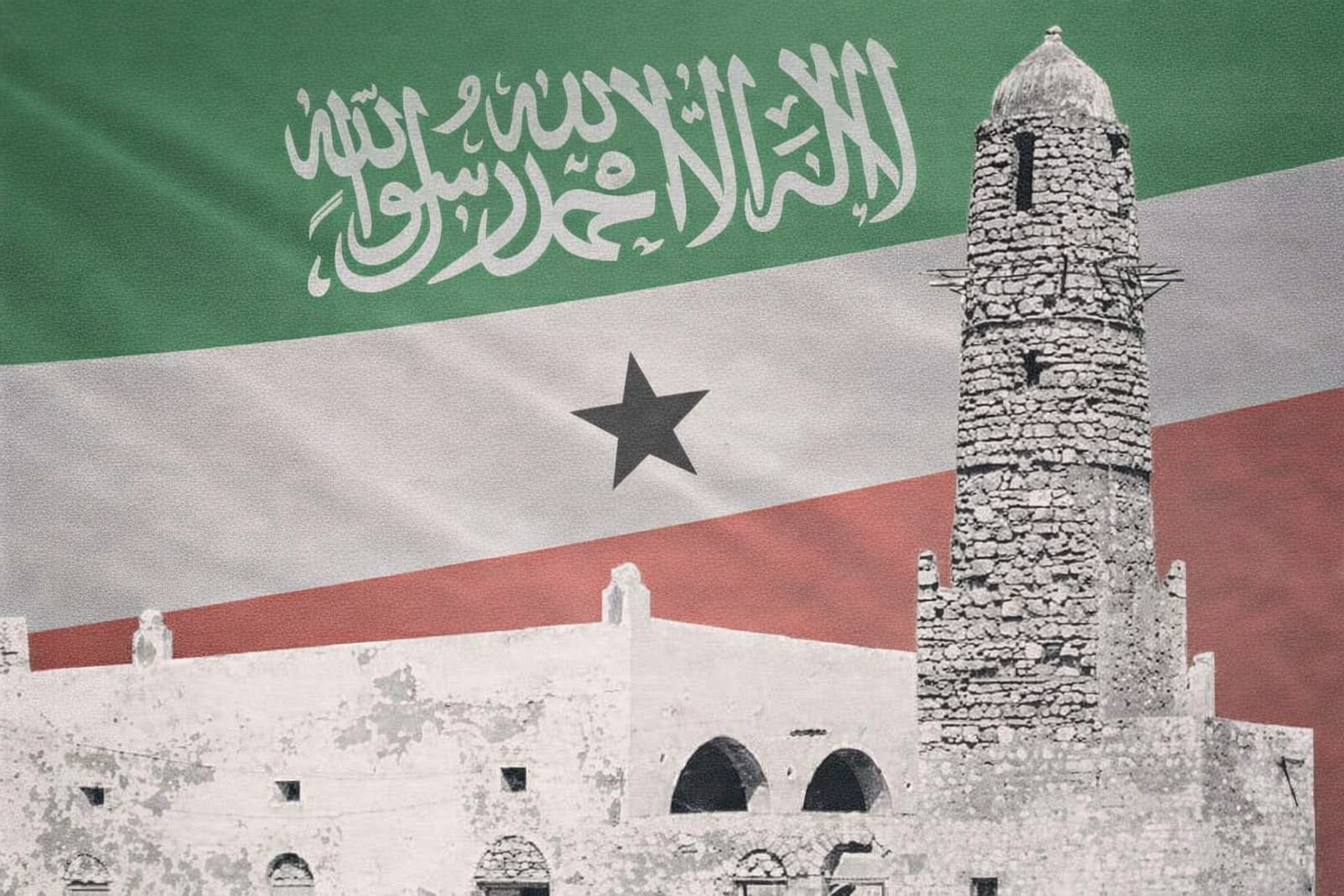
Somaliland's pursuit of recognition has never been an abstract moral exercise. It has always been a strategic necessity. Yet that necessity has opened a deeper question about Islam itself and its future.
I was among the earliest Somaliland advocates to argue that Israeli recognition would be a win-win outcome for Somaliland and the United States. Four years ago, the window was clear. Somaliland had leverage. It was stable, strategically aligned, and capable of absorbing political shock internally. Its public, whilst conservative, was pragmatic. Recognition was achievable.
That recognition materialised on 26 December 2025.
This moment did not arrive in isolation. My long-term work has always followed two tracks. The first was advocacy for Somaliland as a sovereign, democratic state. The second, intended to follow later, was engagement with Islam itself, specifically its renewal, or tajdid. Israeli recognition has collapsed that timeline. Both conversations now have to happen at the same time.
Recognition as Necessity, Not Idealism
Somaliland's recognition was not framed as a moral ideal. It was justified by necessity. In Islamic jurisprudence, necessity permits imperfection when survival or protection is at stake. States operate under the same logic. Somaliland needed recognition to secure its future, deter instability, and protect its people.
Over time, this framing exposed a deeper tension. What if moral standards themselves require renewal? What if the problem is not political hesitation, but inherited ideas that no longer correspond to reality?
Islam has undergone renewals before, each emerging from crisis. In the twentieth century, movements such as the Muslim Brotherhood prioritised power, statehood, and mobilisation. Another strand, most clearly associated with Wahhabism, reduced Islam to rigid literalism, stripping it of context, ethics, and inference. Though distinct, both converged on the same obsessions: Caliphate. Jihad. Power.
These movements were products of their time. They arose under colonial pressure and civilisational shock. But they also left behind intellectual debris that continues to shape Muslim political thinking long after the conditions that produced them have disappeared.
Somaliland as an Unintentional Counter-Model
Somaliland did not set out to challenge these ideas. Yet by existing as it does, it quietly does.
Its political system is democratic. Its religious culture is traditionally shaped by Ash'ari theology and Sufi practice. Authority is decentralised. Legitimacy is derived from consent, not coercion. Religion informs ethics, not domination.
This matters because Ash'ari thought historically developed methods of inference to counter theological excess. That same intellectual discipline can be applied to political theology today. It allows Muslims to ask whether concepts like caliphate and jihad are timeless imperatives or contextual responses that have been misapplied.
Renewal does not mean abandonment. It means restoring proportion.
Reframing Jihad for the Present World
Nearly all references to jihad in Islamic sources are theological. They describe struggle, perseverance, and moral effort. Even the military episodes of early Islam were not wars of expansion or power accumulation.
The Prophet fought the polytheists of Mecca because Islam was banned entirely. Muslims were persecuted, expelled, and threatened with extinction. Armed conflict emerged only after belief itself was criminalised and the community faced annihilation. Similarly, certain Jewish tribes in Medina entered binding political and military alliances aimed explicitly at eliminating Islam at birth, not as a rival faith but as an ideology.
It is therefore a categorical error to abstract these episodes and apply them universally to all non-Muslims or to Jews today. These conflicts were contingent, defensive, and historically bounded. They were never theological commands for permanent hostility.
That context no longer exists.
Freedom of religion is now a global norm. Muslims worship openly across continents. Even in politically contentious places, religious practice is not eradicated. There are more mosques in Tel Aviv today than there were in Mecca at the time of the Prophet. The condition that once justified armed struggle no longer exists.
This does not mean armed struggle has vanished altogether. Legitimate self-defence still exists, but it is governed by restraint, proportionality, and the absolute prohibition on targeting civilians. These principles are already embedded in international humanitarian law and rooted in Islamic jurisprudence itself.
Islam rejects injustice, commands the avoidance of chaos, and instructs believers to obey lawful authority whilst pursuing the wisest and least harmful course of action. The objective is always the removal of oppression, not vengeance, domination, or destruction.
Concepts often cited to justify theological conflict, such as al-wala' wa-al-bara' (loyalty and disavowal), addressed periods of existential religious war. They were never meant to convert modern political disputes over power and resources into religious wars.
Today, struggle is about political equality, dignity, and fair governance. It is not religious war. It is not Muslims versus non-Muslims. Modern conflict mirrors every other human conflict: power, resources, rights, accountability. Framing it as religious is not only inaccurate, it is damaging.
This ethical posture is not theoretical. It is visible in Somaliland's democratic political culture. Many Somalilanders support a two-state solution, even though Palestinian authorities do not recognise Somaliland's own statehood. Disagreement on status has not translated into rejection of principle.
Online hostility has likewise not altered this position. Political disagreement is understood as part of pluralism, not a justification for retaliation. Justice is treated as a standard to uphold, not a tool to withdraw when inconvenient.
This restraint reflects confidence, not indifference. It mirrors the broader Somaliland approach to politics and religion alike. Self-determination for Palestine is not against friendship with Israel. They are all human and should enjoy peace and political rights. Disagreement is managed through institutions, values, and civic discipline rather than escalation or moral absolutism.
Islam Does Not Need Militarisation. It Needs Confidence.
The greatest danger facing Islam today is not external suppression. It is intellectual defeatism. Outdated frameworks have trapped Muslims in arguments that no longer reflect their lived reality.
Here Somaliland offers something rare: a Muslim society that is democratic without apology. Religious without militancy. Traditional without stagnation.
There is a historical symmetry worth noting.
When early Muslims fled persecution, they crossed the Red Sea and landed on the shores of what is now Somaliland. Islam survived because it found protection there.
Today, Islam is again endangered, not by swords or armies, but by ideas that have lost their grounding. Somaliland may once again offer refuge, not for bodies, but for thought.
The next Mujaddid (Renewing Imam) might not be a preacher. Not a hegemon. But a whole society that proved Islam can exist confidently in a plural, democratic, modern world without needing to dominate it.