America once believed its strongest partnerships were with countries that shared its values, open trade, democracy, rule of law, and accountable government. That belief was not sentimental. It was strategic. States that are accountable at home are usually more predictable abroad.
In recent years, Washington drifted toward a more transactional model. It embraced authoritarian partners in the name of pragmatism and treated democratic alignment as a luxury. The result is now visible from Tehran to Djibouti.
America spent years renting dictators while overlooking democracies.
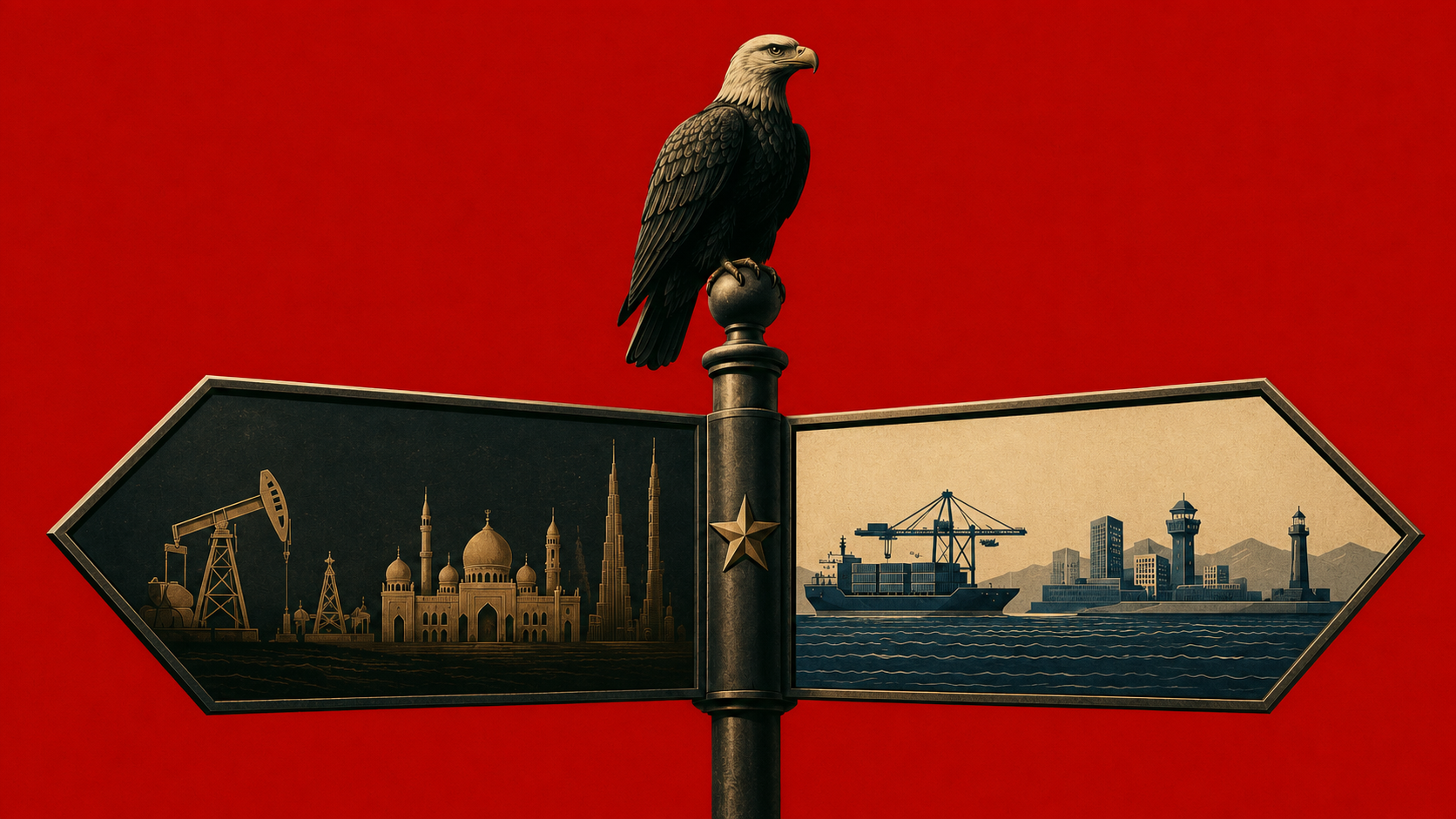
The image of an eagle above a forked signpost captures the choice. One road points toward oil, palaces, and closed systems. The other points toward ports, open sea lanes, and accountable government. Washington has spent too long mistaking the first road for realism.
The Rental Model
Dictatorships can look efficient from a distance. They speak with one voice, sign deals quickly, and promise stability. That is why they are attractive to impatient foreign policy establishments.
Yet their first loyalty is always regime survival. They bargain from fear, not principle. They cooperate when it strengthens their grip and hesitate when the cost becomes domestic, regional, or personal.
MBS disappointed America on Iran because the Saudi position revealed the limits of a partnership built around transactional leverage. When Washington needed dependable alignment, the answer was not automatic strategic support. It was calculation.
The UAE shows the other side of the same equation. It has often been a more dependable partner because it relies on global trade, markets, ports, aviation, logistics, and international confidence. Even within the Gulf, the same ingredients matter. The Freedom House Report 2026 reflects the UAE's wider margin of openness compared with Saudi Arabia. That matters because a country plugged into open commerce, with more room for citizens and residents to breathe, has stronger reasons to remain aligned with the West.
That is the lesson. The more a state depends on openness, markets, and global confidence, the more dependable it becomes. Somaliland offers those ingredients in an openly democratic African setting.
This is the central flaw in rented power. It works until the moment it matters.
Djibouti Warned Us
Djibouti offers the second warning. Ismail Omar Guelleh opened the door to China's expanding influence at one of the world's most strategic chokepoints. A country hosting major Western assets also became a platform for Beijing's military and commercial reach.
That is not an accident. It is the logic of authoritarian bargaining. A ruler who faces little domestic accountability can turn geography into auctioned influence. Every great power becomes a tenant. Every base becomes leverage.
This is why the Djibouti model should unsettle Washington. The issue is not only Chinese presence. The issue is dependency on a political system that can monetise strategic access without sharing America's values or long term objectives.
As I argued in The Paragon Lock, Somaliland's value is not merely its coastline. Its value is the combination of geography, legitimacy, and alignment. That combination is rare in the Horn of Africa.
Berbera Matters
The recent crisis around Iran has exposed the limits of the existing basing architecture. If expensive partnerships with authoritarian regimes cannot reliably help contain Iran, counter China, or secure critical shipping lanes, then Washington should ask harder questions.
Berbera offers strategic depth at the crossroads of the Red Sea, the Gulf of Aden, the Arabian Sea, and the Indian Ocean. It sits near the maritime corridors that connect Africa, the Gulf, the Middle East, and Asia. It gives Washington options beyond overused and politically fragile arrangements.
This is not a fantasy of geography. It is the basic logic of maritime power. The Bab al Mandab and the Gulf of Aden matter because commerce, energy, naval movement, and regional deterrence pass through them. Berbera sits inside that strategic map.
The case was already clear in Le Monde's Berbera Fiction. Somaliland is not a passive object in someone else's security design. It has agency, interests, and a coherent strategic offer.
The Better Ally
Somaliland cannot compete with oil rich states in wealth, and it should not try. Its value is different. It offers democratic legitimacy, political stability, open trade, and genuine strategic alignment with the West.
It is democratic.
It is stable.
It is pro Western.
It protects its coast.
It has every reason to keep shipping lanes open.
That is the kind of partner Washington says it wants. It is also the kind of partner Washington too often ignores because it lacks oil money, formal recognition, and diplomatic theatrics.
This is where the recognition question becomes strategic, not symbolic. As argued in State Recognition Is Not a Group Order, America does not need permission from failed frameworks to recognise political reality. Somaliland has built the institutions, maintained the peace, and aligned with the democratic world.
Conclusion
The lesson is simple. Renting dictators may seem pragmatic in the short term, but it often produces unreliable partners when pressure rises. Authoritarian regimes prioritise survival and bargaining power over shared values.
Somaliland represents a different model. It offers strategic value backed by shared interests and shared principles. That is the kind of partnership that lasts.