Somaliland is not misunderstood because it is invisible. It is misunderstood because its internal logic has never been clearly explained.
The core argument is simple: Somaliland operates on a distinct civilisational, political, and social framework that differs fundamentally from Somalia and much of the region.
For external actors, including Australia and other Indo-Pacific partners, this matters. Engagement with Somaliland cannot be effective without understanding how its society thinks, decides, and acts. Somaliland is not driven by desperation for recognition. It is driven by internal legitimacy, consensus, and long-standing cultural logic.
A Civilisation Built on Exchange
Somaliland's identity begins with geography. Positioned along historic trade routes, it has interacted with ancient Greeks, Egyptians, Arabs, Persians, and Chinese traders for centuries. Berbera is one of the oldest cities in Africa.
This is not a peripheral detail. It defines a mindset. Somaliland developed as one of the earliest open trading societies, where exchange, negotiation, and coexistence were normalised. Open markets are not a modern import. They are embedded in its historical DNA. For Somalilanders, free trade is like breathing oxygen. It is not something chosen; it is something inherited.
This produces a population that sees engagement with the outside world as natural rather than threatening.
Religion by Choice, Not Imposition
Somaliland's Islamic tradition also diverges from common assumptions. Unlike the Saudis in the Najd, the Turks, the Egyptians, or the Pakistanis, Somalilanders came to Islam through choice, not through sword or jihad.
This produced a Sufi influenced, Ash'ari tradition emphasising the purification of the soul, spirituality, personal conduct, and good manners. Religion became associated with ethics and behaviour rather than political mobilisation. The early Somaliland history of being open and friendly resonated when its people encountered Islam in this form, and it reinforced rather than replaced their existing values.
Wahhabism has eroded some of that foundation in the last 50 years, but the older generations and the broader Somaliland culture remain anchored in that particular tradition. People love to put every Muslim into one bucket, but the history and the details are what count.
The long-term effect is critical. Somaliland society developed a built-in resistance to ideological extremism. When the "Mad Mullah," an outsider from the Ogaden region of Ethiopia, arrived with a more violent sect of Sufism and called for jihad against Britain (but curiously not against Italy), Somalilanders recognised it for what it was: a power grab dressed in religious language. They said, "This is not the Islam we know."
Somaliland effectively faced the first version of terrorism at the turn of the twentieth century. That experience gave Somalilanders a natural DNA to reject transnational political Islam and the idea of the Khilafah. They cannot be easily persuaded by these movements because they have this history.
A Protectorate, Not a Colony
The colonial experience further shaped Somaliland's distinct path. Unlike Somalia under Italian rule, Somaliland functioned as a British protectorate with minimal direct control. Britain had at most 150 British subjects in British Somaliland, compared to 50,000 Italians in Somalia. Somalia was being transformed into an Italian colony in the fullest sense, whereas in Somaliland there was no British colony, no suburb even inhabited by British settlers.
This meant one thing: Somalilanders kept their culture, their values, and their institutions. They did not go through the erosion that happened to many other places.
Even the decision to enter the protectorate system was strategic. Similar to how they became Muslims by choice, Somaliland clans became part of the British protectorate by choice. Treaties were signed after interactions through trade and some friction with British vessels. Later, Somaliland clans saw the threat of Ethiopian expansionism and concluded that the deal would protect them. It was a geopolitical choice, deliberate and calculated.
Because Somaliland entered this arrangement willingly and retained its internal governance, there was no need for a liberation struggle against colonisation. The population was broadly content with the arrangement.
Democracy from Within
Somaliland's democratic system is often mischaracterised as externally adopted. That is a significant misconception. Somaliland did not pick democracy from abroad to win recognition.
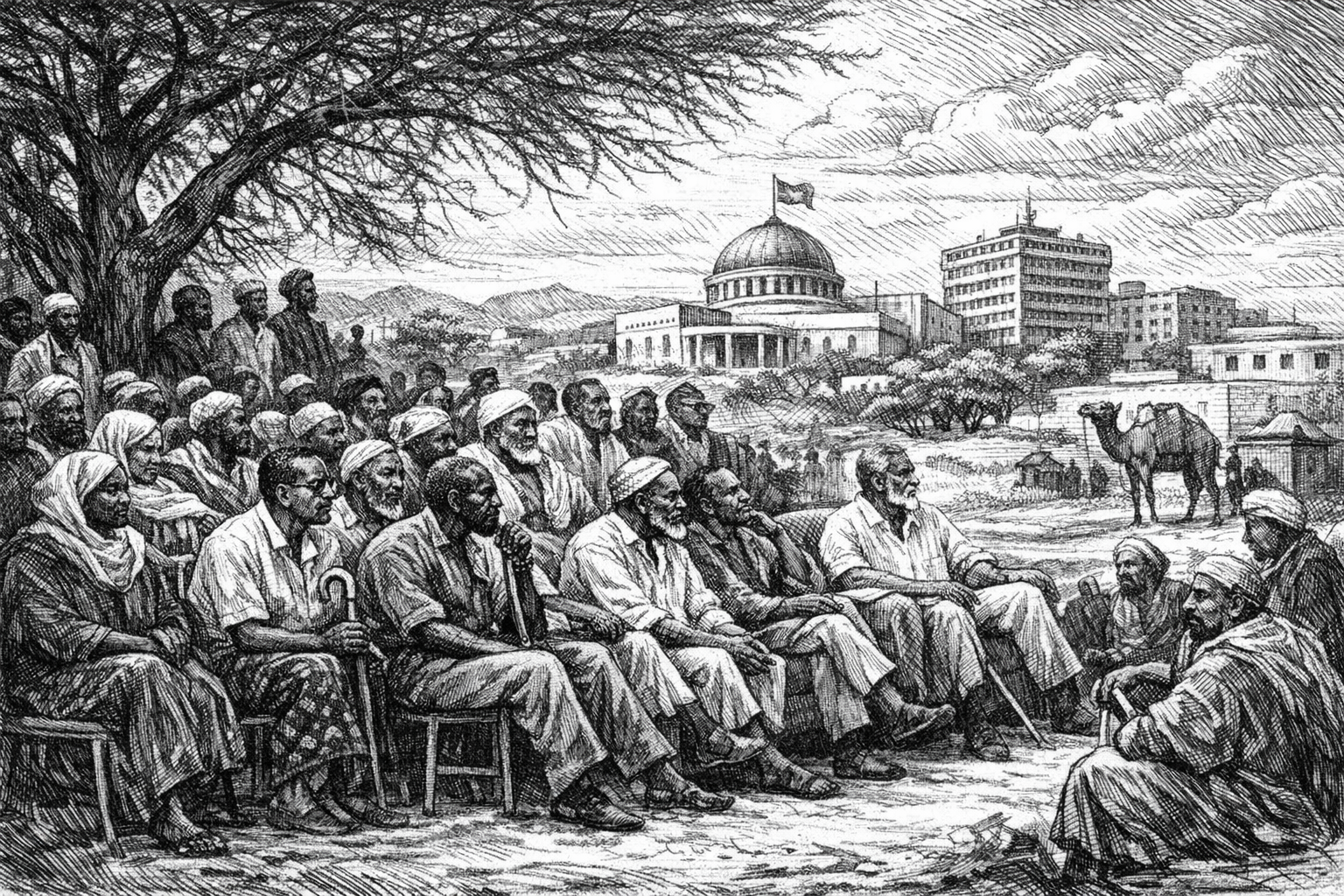
To understand why, one must look at Somaliland's pastoral democracy, documented extensively by I.M. Lewis. When clans faced decisions about war and peace, they sat under a tree and every man gave his view. They did not cast formal votes but developed a clear sense of where the majority stood, and everyone was listened to. This process translated naturally to a parliamentary system and eventually to one man, one vote.
Somaliland sees democracy as a universal value that different civilisations arrive at through different paths. For Somalilanders, it meant taking the process from the clan level to the national level. The freedom struggle against Siad Barre's dictatorship reinforced this. The value system of Somalilanders, rooted in centuries of consensual governance, clashed fundamentally with a dictatorial system imported from a society shaped by Italian fascist rule.
A System of Balance, Not Dominance
Somaliland does not have one clan that dominates. All seven tribes (seven because each signed a treaty independently with Britain) live on shared, overlapping grazing areas. They learned how to work together out of necessity. Although loyalty has always been to the clan, every group must build alliances with its neighbours to win elections and govern effectively.
Identity politics exist within Somaliland, as they do everywhere. But the alliances are dynamic. There are no fixed coalitions. This internal composition, combined with a democratic tradition, makes Somaliland resilient as a whole.
No actor can govern unilaterally. Stability is achieved through balance rather than control. This forces political actors to build consensus and discourages authoritarian consolidation.
Conflict and Resolution
Somaliland has a culture of "fight and move on." Disputes can be intense and even nasty. But then comes a deliberate effort to restore coexistence because the alternative, perpetual hostility in Cold War fashion, means the conflict will never end.
This shaped how Somalilanders responded to the Gaza war. When the conflict began, Somalilanders paused their campaign for Israeli recognition. As soon as peace was signed between all parties including Hamas, the view was clear: it is time to make peace, and peace must be taken seriously. Closing that chapter and starting a peaceful endeavour was pragmatic, consistent with how clans have always operated. You fight, and then you move on.
This is another cultural value that sets Somalilanders apart. Decisions are guided by pragmatism and timing rather than rigid ideological positions.
The Strategic Implication
Understanding this mindset changes how Somaliland should be engaged.
It is not a fragile entity seeking validation. It is a politically mature system that prioritises internal consensus over external approval. Government actions often reflect public sentiment because legitimacy flows from society upward.
Back to the example of Israel's recognition. His decision came as a surprise to many external observers. But not if you were following Somalilanders on X. For over five years, voices from across the diaspora and at home had been discussing how strategic engagement with Israel would be. This was before the war, during the pause it created, and after peace was restored. The government followed through on what the people wanted. That is a clear indication that in Somaliland, the government follows public discourse.
Conclusion
Somaliland is distinct not just in its political status, but in how it thinks.
It is a society shaped by trade, choice, consensus, and pragmatism. Its governance is rooted in tradition yet adapted to modern statehood. Its stability is not imposed; it is negotiated continuously.
Any serious engagement must start here. Understanding the Somaliland mindset is not optional. It is the entry point.