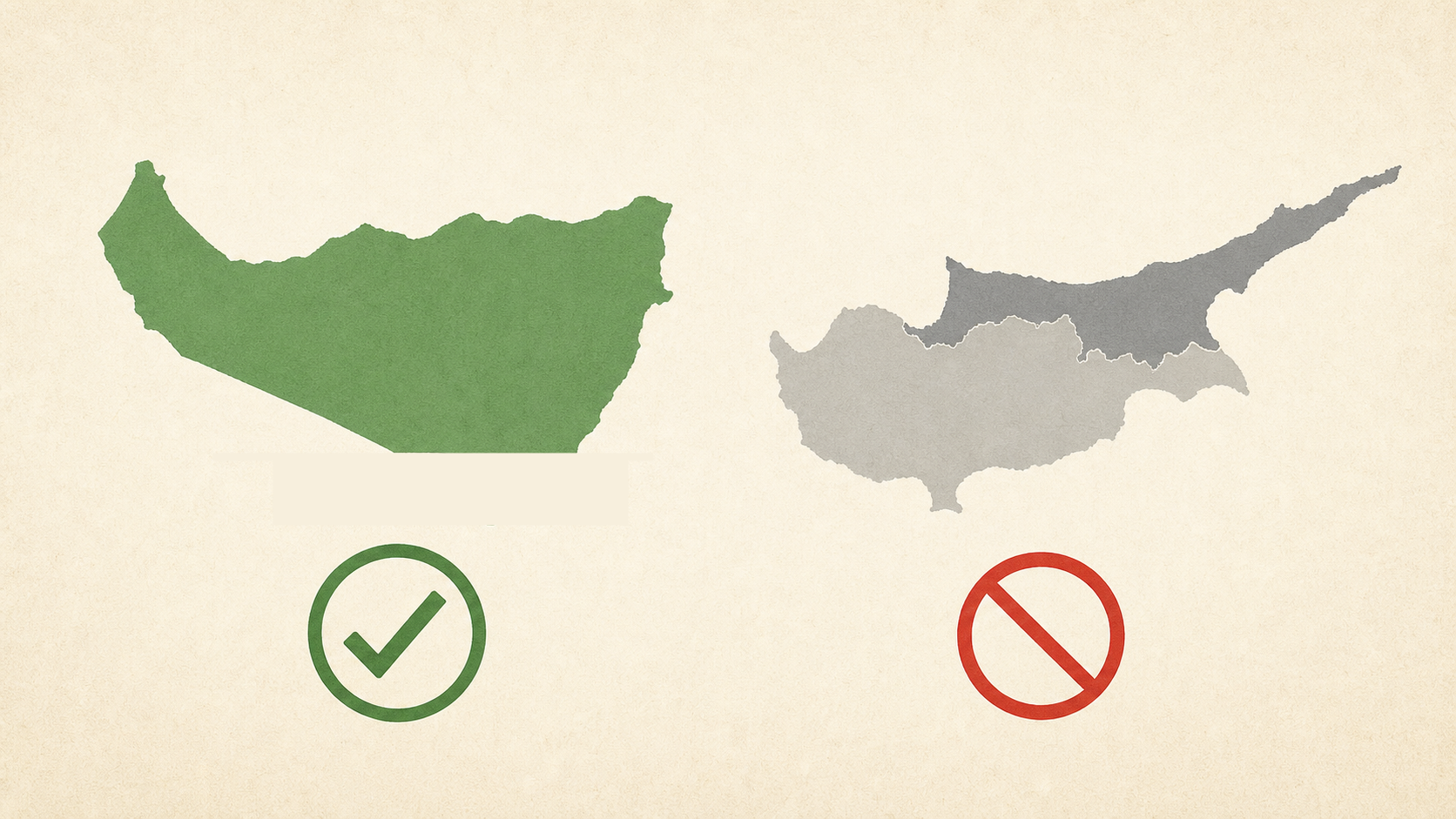
Today marks 52 years since Türkiye's illegal invasion of Cyprus on 20 July 1974, the military action from which Northern Cyprus ultimately emerged. Somaliland and Northern Cyprus are each recognised by one United Nations member state. Israel recognises Somaliland, while Türkiye alone recognises Northern Cyprus.
Recognition is not arithmetic. Northern Cyprus faces an express United Nations rule of nonrecognition, while Somaliland faces political opposition without an equivalent legal prohibition. Foreign ministries must distinguish an open door from a locked gate before invoking territorial integrity as though both cases were the same.
Force Created Northern Cyprus
Northern Cyprus was proclaimed in 1983 on territory brought under Turkish control in 1974. It did not restore an earlier sovereign country within former international borders; its territory was inseparable from external force and demographic separation.
The entity's origin was also sectarian. The United Nations records that clashes between Greek Cypriots and Turkish Cypriots preceded the Turkish intervention that established northern control. The European Court of Human Rights later found a continuing violation because displaced Greek Cypriots were denied return to their homes in the north. A political order consolidated through sectarian violence, mass displacement and an enforced bar on return is ethnic cleansing in substance, not a neutral exercise of self determination.
Article 2 of the United Nations Charter restrains states from using force against other states, preventing armies from changing international borders and converting the result into a new sovereign fact.
The Security Council therefore did more than criticise Northern Cyprus. Resolution 541 declared its secession legally invalid and called on every state not to recognise any Cypriot state other than the Republic of Cyprus. Resolution 550 repeated that instruction and called on states not to assist the purported entity. An official European Union review records that Northern Cyprus remains recognised only by Türkiye.
Somaliland Restored Its State
Somaliland has the opposite origin. British protection began through treaties with Somaliland communities, not through a foreign army or a transferred settler population. The native political community of that territory attained independence when the Somaliland Order in Council ended British protection and established Somaliland as an independent country on 26 June 1960. Five days later, it went into a de facto union with the State of Somalia, which had formerly been administered by Italy. The attempted union was between two sovereign countries, not between regions.
Somaliland restored its sovereignty in 1991 within the borders it possessed at independence. It did not ask a neighbouring army to seize new land. Its claim follows the Organisation of African Unity rule that states must respect the borders existing at national independence.
Somaliland's state continuity asks the world to recognise a border fixed at decolonisation, rather than accept one produced by external force.
Kosovo Separates Two Questions
The International Court of Justice clarified the distinction in its Kosovo advisory opinion. International law contains no general prohibition on declarations of independence, and territorial integrity principally governs relations between states. The Court explained that condemnations of Northern Cyprus and similar cases arose because their declarations were connected to unlawful force or other grave violations. Kosovo had received no such determination, so its declaration did not violate international law.
The Court did not recognise Kosovo, create a general right to secession or decide Somaliland's status. Its narrower holding prevents the misuse of territorial integrity to turn an interstate rule against force into an automatic veto over recognition.
Recognition Faces Political Choices
Türkiye condemned Israel's recognition of Somaliland as unlawful interference and supported Somalia's "territorial integrity". Ankara's unique recognition of Northern Cyprus makes a future exchange tempting to imagine, with Türkiye accepting Somaliland if others accept Northern Cyprus. There is no public evidence that Ankara has proposed such a bargain, and resolutions 541 and 550 make the equivalence false.
The strongest objection deserves a direct answer. Resolution 2809 reaffirms "Somalia's sovereignty, territorial integrity", political independence, and unity. That does not concern Somaliland since no external force is changing Somalia's borders. The resolution does not declare Somaliland's restoration legally invalid or instruct states not to recognise it. That specific language appears in the Northern Cyprus resolutions and is absent from the Somaliland case.
Foreign ministries should apply a simple Recognition Gate Test. Did unlawful interstate force create the claimed entity or its borders? Has the Security Council declared its independence invalid and required nonrecognition? Northern Cyprus answers yes twice. Somaliland answers no twice.
Somaliland's foreign ministry should place this test at the centre of every recognition brief. Governments considering recognition should publish their answers, treat regional objections as political inputs rather than legal vetoes, and reject any attempt to trade Somaliland against Northern Cyprus. Legal clarity does not compel recognition, but it prevents a political refusal masquerading as a legal obligation, the distinction behind State Recognition Is Not a Group Order.
Politics Delays Legal Clarity
One recognition does not mean one opportunity. In November 2006, United States Assistant Secretary of State Jendayi Frazer backed an approach under which Washington would recognise Somaliland if the African Union moved first. The opening stalled through political deference, not a legal prohibition.
Ethiopia moved closer in January 2024. Somaliland said its sea access memorandum with Ethiopia provided for recognition, while Addis Ababa committed to assess its case. Ethiopia stopped short, then yielded to political coercion in December by joining the Ankara Declaration and reaffirming Somalia's claim over Somaliland. The policy changed within one year. The governing legal materials did not.
Israel converted possibility into recognition on 26 December 2025. It did not create Somaliland, draw its borders, or install its government. Israel's foreign minister later described the act as a return to Israel's position when Somaliland became independent on 26 June 1960.
Somaliland waits for another government to change its mind. Northern Cyprus waits for international law to change its answer. That is why one recognition can be the first while the other remains the last.