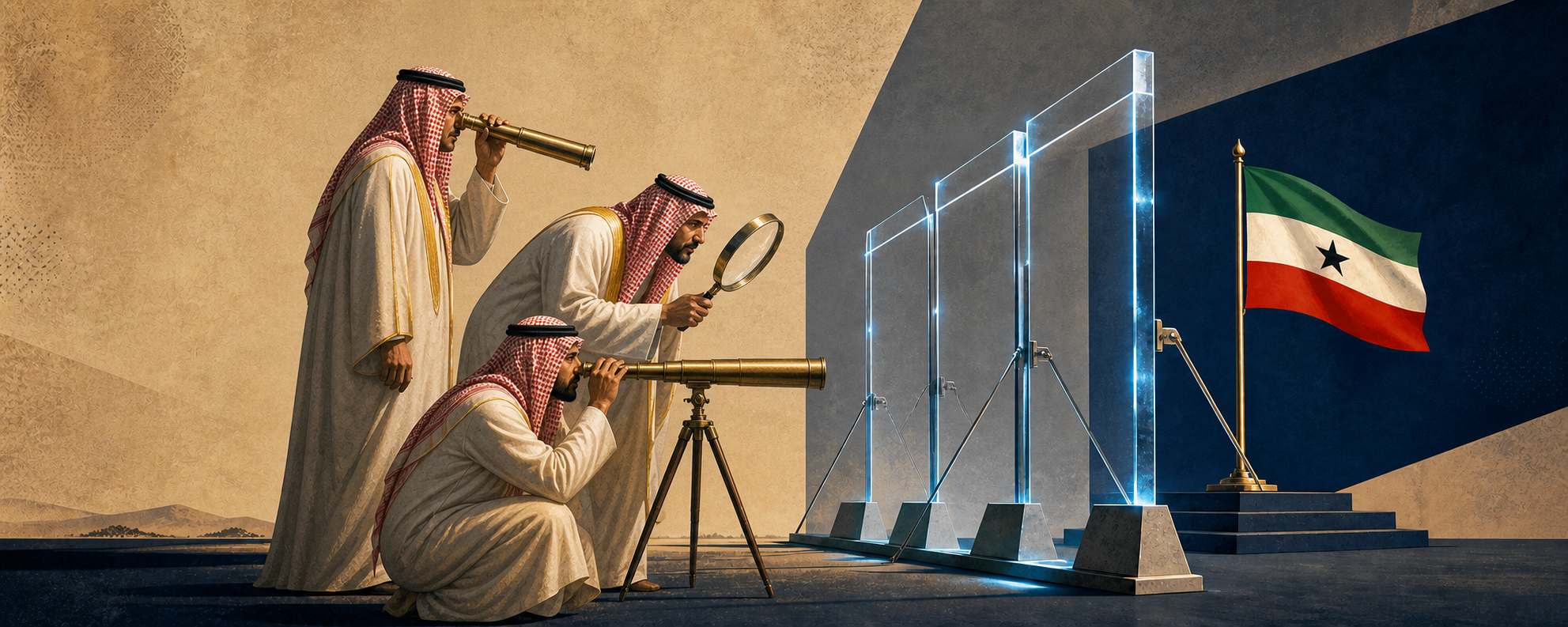
Saudi excitement over a pickup truck reveals how far its Somaliland ambitions have shrunk. On 27 December, the day after Israel recognised Somaliland, parts of Saudi and Somali X imagined Saudi F-15s repeating Riyadh's Yemen playbook over Hargeisa. Days later, Saudi Arabia struck an arms shipment bound for Yemen's Southern Transitional Council. Eight months on, the fantasy has contracted from fighter jets to around ten men as international deterrence raises the cost of testing Somaliland.
On 19 August, Colonel Ali Ahmed Ismail, known as Ashkato, left Somaliland's forces near Yubbe and joined the Dhulbahante clan militia. Local reports counted one vehicle and about ten soldiers, a figure not independently verified. Saudi political writer Suleiman al-Oqaily nevertheless presented them as a "large unit", spreading the claim across Saudi X. Neither Somaliland nor Puntland was shaken, while Horn observers saw a routine defection reported by one side. Saudi commentary manufactured a geopolitical earthquake. That is not military collapse. It is a pickup truck with a public relations department.
Loyalties in Sool and Sanaag move both ways. In April 2025, a Dervish commander in the Dhulbahante clan militia resigned amid reported disagreements. In July 2026, Fahiima Yuusuf Quuje, a prominent participant in the 2023 campaign against Somaliland, resigned and returned to Somaliland, followed by five other politicians aligned with the militia. Hargeisa did not declare the entire militia finished. These movements demonstrate local fluidity, not national collapse.
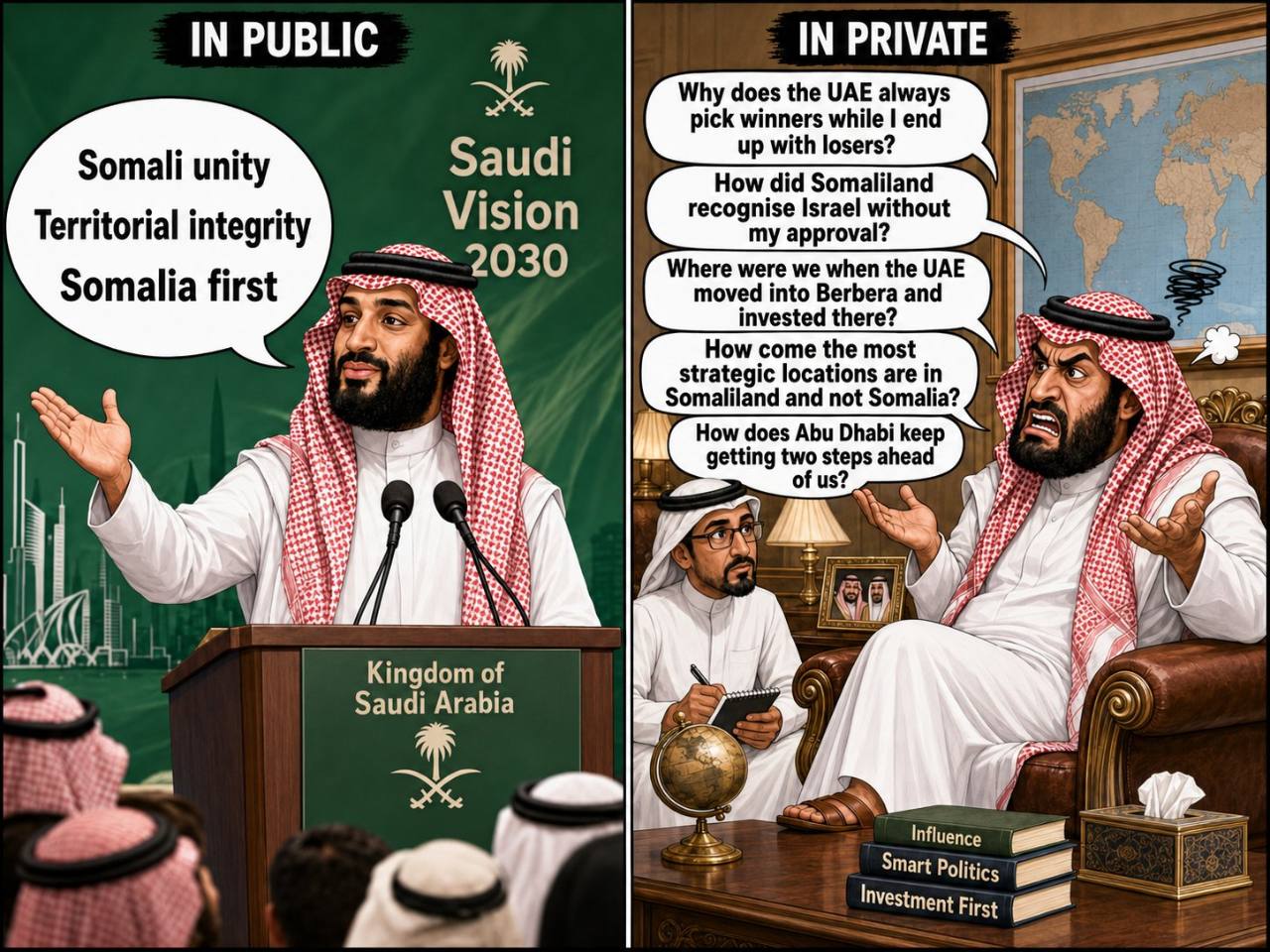
Saudi Arabia had Horn interests, but its political discourse showed little sustained curiosity about Somaliland's elections, institutions or security for 35 years. This was never ignorance at the top. In August 2018, King Salman received Somaliland Vice President Abdirahman Saylici at his Hajj reception alongside presidents, vice presidents and senior Muslim world officials. Riyadh knew the country and its leaders; its accounts now study Dhulbahante family trees because Somaliland sits inside the UAE's successful Berbera strategy.
Riyadh increasingly treats an independent Emirati gain as a Saudi loss. That insecurity persisted even after Iran attacked the UAE, while the wider Iran war deepened the Saudi and Emirati rift. The excitement reveals a desperate wish in parts of Saudi and Somali discourse for Somaliland to weaken or descend into the chaos that destroyed much of the region. Fighter jets have given way to a few feeble warlords, with jealousy overwhelming strategic proportion.
Israel's recognition changed the equation. Hargeisa controls its airspace, so any Israeli access would be negotiated with Somaliland, not granted or withheld by Riyadh. AFRICOM's visits to Hargeisa and Berbera reinforce relationships with the dominant external military power in the Horn. Together, these links strengthen Somaliland's international deterrence. They do not promise immunity, but sharply raise the price of a reckless Saudi adventure across the Red Sea.
Somaliland condemned Iranian attacks on the UAE before the Gulf Cooperation Council and European Union meeting and before the Arab League meeting. Its position carried more weight than belated objections, revealing who protects Arab interests when taking a stand has a cost.
Washington should complete the firewall through recognition, a sovereign national decision that requires no Arab League group order. Call this reason No. 99. Washington should tell Riyadh to stick to Sudan and Yemen. Somaliland will not become its third theatre.
When Riyadh needs a magnifying glass to turn ten men into a strategic triumph, the lens becomes the story. Somaliland has not shrunk; Riyadh's picture of it has lost its scale.