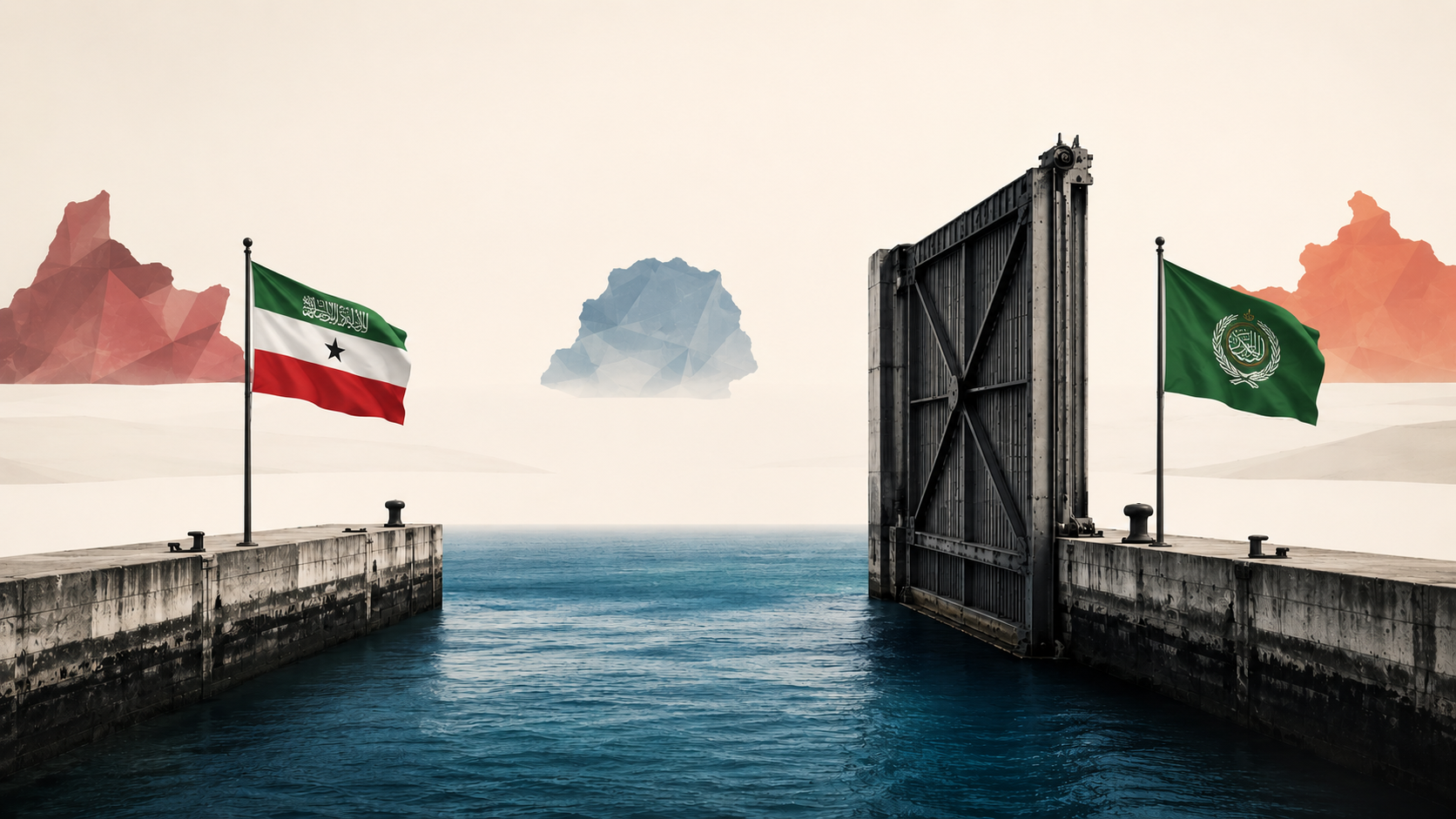
After more than three decades, it is time to revisit some of the assumptions that have shaped Arab thinking about the Horn of Africa.
Too many policies were built on inaccurate premises, then their authors were surprised when the results disappointed them.
Any strategy that begins with a wrong map ends with a wrong policy.
Start With Facts
The first fact is simple. Somaliland is not Arab.
Somalis are not Arabs in the national, linguistic, or historical sense. They are a Cushitic African people, and the Somali language belongs to the Cushitic branch of the Afro Asiatic family, as Britannica notes in its entry on the Somali people. Somaliland belongs naturally to the Horn of Africa.
This is not an insult to Arabs. It is only a fact. Turks are not Arabs. Iranians are not Arabs. Ethiopians are not Arabs. Somalis are not Arabs either.
Respecting identity builds partnerships. Trying to redefine peoples to fit inherited political imagination only builds misunderstanding.
The second fact is just as basic. Somaliland is not on the Red Sea.
Somaliland sits on the Gulf of Aden. The Gulf of Aden is a distinct basin between Arabia and the Horn of Africa, linking the Red Sea and the Arabian Sea, as Britannica describes it. Confusing the Red Sea with the Gulf of Aden has produced a shallow understanding of the region, its interests, and its balance of power.
The third fact is broader. The Horn of Africa is not an extension of the Arab world. It is an African region beside the Arab world.
It is an important neighbour.
It is not a subordinate space.
Anyone who wants a successful policy toward the Horn of Africa must first deal with it as it is, not as they wish it to be.
The Neighbour
There is another fact that cannot be jumped over.
Ethiopia.
Whether some like it or not, Ethiopia is one of Africa's major powers. The World Bank describes Ethiopia as the second most populous country in Africa, with about 135.9 million people in 2025. It will remain central to the region's equations.
Somaliland is tied to Ethiopia by language, ethnic, geography, history, economics, and shared interests. Geography cannot be voted away. No diplomatic resolution can abolish it.
Somaliland is entitled to make whatever lawful agreement it wants with Ethiopia regarding its own coast. The argument sometimes heard from Cairo, that Ethiopia is not a coastal country and therefore should have no maritime arrangement through Somaliland, is illogical. This is not the Red Sea. Egypt has no coast on the Gulf of Aden. Saudi Arabia has no coast on the Gulf of Aden. Turkey has no coast on the Gulf of Aden. Just as Egypt has no veto in the Black Sea, it has no veto over the Gulf of Aden.
The practical record is even clearer. Houthi attacks on shipping devastated traffic through the Suez route, and Associated Press reported that Suez Canal revenue fell from 10.25 billion dollars in 2023 to 3.991 billion dollars in 2024. That is more than 6 billion dollars in lost annual revenue, and Egypt did not prevent that damage. A stronger partnership between Somaliland, Ethiopia, Israel, the United States, and other serious actors would help ensure that violent non state actors do not threaten Bab al Mandab and the wider Gulf of Aden corridor.
Any Arab strategy that ignores Ethiopia, or treats the Horn of Africa as if it can be separated from Ethiopia, is condemned to fail. This is why the Somaliland and Ethiopia question cannot be reduced to slogans, as I argued in The Somaliland Ethiopia MOU.
Denial Failed
For more than thirty years, many people bet that Somaliland would disappear.
It did not.
They bet that it would collapse.
It did not.
They bet that it would return to Mogadishu.
It did not.
After more than three decades, Somaliland still exists, with institutions, government, elections, external relations, an economy, and security. One may support this reality or oppose it. One cannot deny it.
Denial is not policy.
It is only a delay in admitting the truth.
The Lost Space
The problem is not merely that Arabs lost influence in the Horn of Africa. The deeper problem is that many behaved as if influence would arrive automatically.
Somaliland was ignored for decades. Serious relations were not built. Political and economic energy was not invested in understanding it or communicating with it.
But a vacuum does not remain a vacuum.
When one actor is absent, another arrives. When a strategic space is left empty, someone else fills it.
This is not a conspiracy. This is the nature of international politics.
That is the point I made in To Riyadh, Do not lose Somaliland. Somaliland was not created by the attention of others. It became available to others because Arab policy mistook absence for principle.
The Emirates
The exception is the United Arab Emirates.
The UAE did what others only discussed. It invested. DP World committed up to 442 million dollars to develop Berbera Port, the greatest Arab backed investment in Somaliland's modern history. It treated Somaliland as a real place with real infrastructure, not as a diplomatic embarrassment to be avoided.
That is why the UAE occupies a different emotional and political place in Hargeisa. The Arab flag that Somalilanders have raised with warmth in Hargeisa is the Emirati flag. Symbols matter because they reflect memory. Somalilanders remember who came, who invested, and who treated them with respect.
The same logic appeared when Iran struck Gulf and Arab states. Horndiplomat reported that Somaliland strongly condemned Iranian strikes on the UAE, Qatar, Kuwait, Bahrain, Saudi Arabia, and Jordan on 1 March 2026, while Mogadishu remained silent. That statement was not a small gesture. It showed that Somaliland can disagree with Arab capitals on recognition while still taking a clear position for Gulf security when the region is threatened.
The UAE also understands Ethiopia. Its relationship with Addis Ababa is not accidental, and the UAE itself describes a long record of political, commercial, and investment cooperation with Ethiopia, including major support announced in 2018. That makes Abu Dhabi one of the few Arab actors able to see Somaliland, Ethiopia, and the Gulf of Aden as one strategic picture rather than three separate files.
Israel As Result
If some Arab capitals are now worried about growing ties between Somaliland and Israel, they should ask a simple question.
Who left the space open?
Somaliland did not move. It did not change its geography. It did not turn its back on the region.
What happened is simpler. Many chose to ignore it for years.
Further isolating Somaliland will not reduce Israeli influence. It will only make Israel the only actor that benefits from partnership with it.
The path to reducing the influence of others is not absence. It is presence.
It is not boycott. It is competition.
It is not leaving the field. It is entering it.
Whoever wants a role in Somaliland must come to Somaliland. Leaving it to others, then complaining about their influence, is not a serious strategy. It is the same illusion that keeps reappearing in different forms, the illusion described in Stop Subsidising the Illusion.
A Real Opportunity
Instead of treating Somaliland as an irritating file, the Arab world can treat it as an opportunity.
It is an opportunity to build a real bridge between the Arab world and the Horn of Africa. It is an opportunity to build better relations with Ethiopia and the deeper African economy. It is an opportunity to strengthen trade, maritime security, investment, and regional cooperation.
The Arab world does not need more hostility in its neighbourhood. It needs stable partners.
Somaliland can be one of those partners.
That requires a change in method. The League of Arab States should form an independent Arab fact finding mission to study Somaliland on the ground. It should open direct channels with Hargeisa. It should develop economic, cultural, and security relations away from inherited slogans. It should build a Horn of Africa policy from geographic, demographic, and political facts, not old assumptions.
Recognition is not a group order, and Arab consensus is not a substitute for reality, as I argued in State Recognition Is Not a Group Order. A serious Arab policy would not begin by asking how to preserve a fiction. It would begin by asking how to protect interests in the world that actually exists.