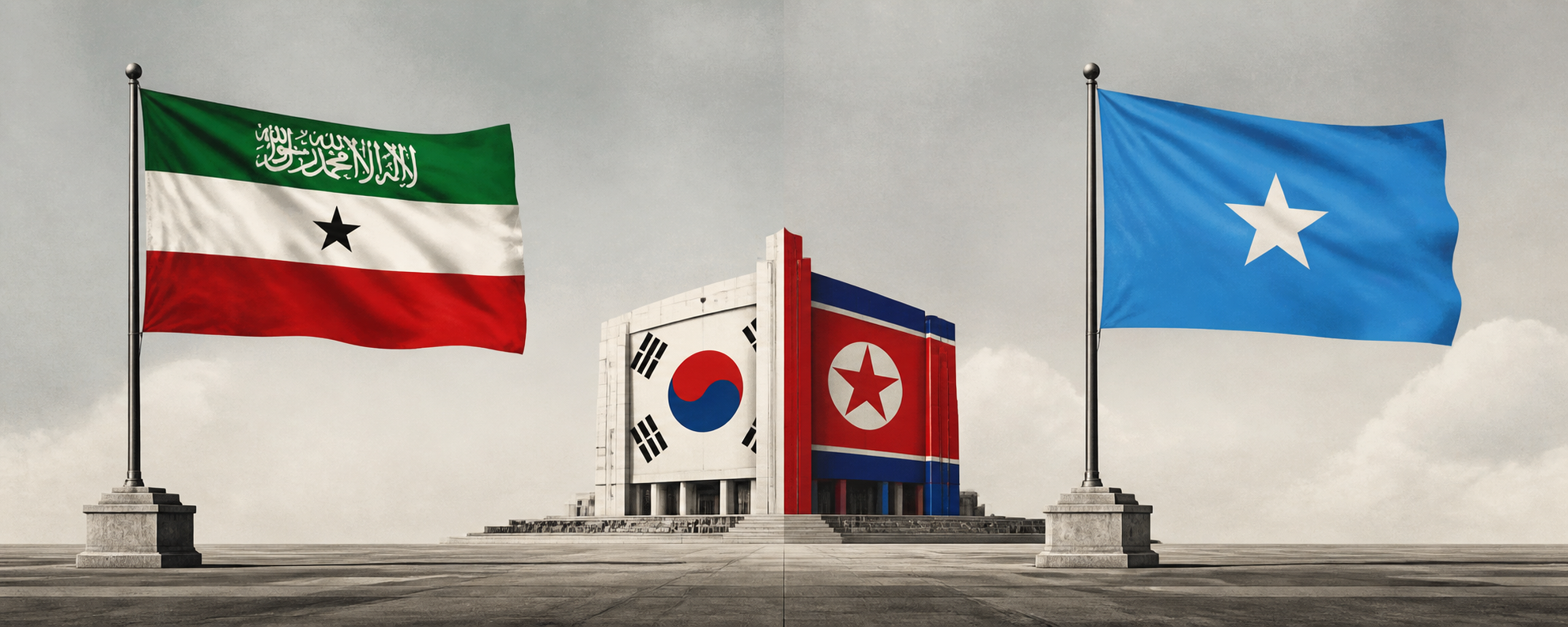
Most people need a shortcut to understand Somaliland, and I use one myself. Think of Korea. Two peoples who share language, ancestry and history, split by politics and war, living under completely different institutions. The comparison usually lands. But it understates the distance between Somaliland and Somalia, because in important respects the two are a harder case than North and South Korea.
Part of the reason more people do not reach for this comparison is our own doing. We kept framing the difference between Somaliland and Somalia as it stood in 1960 or immediately after 1991, repeating that thirty five years have passed since 1991 without turning that time into the equivalence the Korean example commands. Eighty years turned Korea's division into an accepted fact of the map; thirty five years of restored sovereignty deserve the same transformation. The comparison made little sense in 1960 or even 1991. It makes sense today, because only now have the two societies accumulated enough separate experience for the parallel to become visible.
There is a second reason the comparison is rarely made, and it belongs to the world as much as to us. The world recognised both Koreas, but only one of the two Somali speaking countries. That point is moot. The lack of recognition of Somaliland until 2025 did not change how its people acted; they continued to behave as a recognised state regardless of the world's view. The overstatement of the world's position is a bias of outsiders, visible in their collective coercive attempts to force a union.
Somalia is obviously not North Korea. North Korea is one of the most totalitarian states on earth. The comparison is not about tyranny. It is about how two societies that share blood can develop entirely different political identities and institutions. Once you look closely, the Korean analogy runs in reverse.
Histories Run Reverse
Korea was one country before it was divided. In 1945 the United States and the Soviet Union cut the peninsula at the 38th parallel as military occupation zones, and American diplomatic records described the division as arbitrary and temporary.
Somaliland and Somalia travelled the opposite road. British Somaliland became the independent State of Somaliland on 26 June 1960, under the Somaliland Order in Council, which ended British protection and declared an independent country. Five days later, on 1 July 1960, Somaliland went into a de facto union with the State of Somalia, which had formerly been administered by Italy. Two separately administered territories attempted to become one, and that attempted union was never completed as a legal arrangement, as set out in The Union That Never Existed.
The questions are therefore different. Korea asks whether a divided country can become one again. Somaliland asks whether two territories that attempted union in 1960 can be forced back into it after that union collapsed. Nobody asked Koreans in 1945 whether they wanted their country cut in two. Somaliland's current separation followed the collapse of the 1960 union, and United States human rights reporting described its claimed boundaries as equal to those of the state that achieved international recognition in 1960, a territory shaped by a separate British protectorate, not by a border imposed from outside. The separation followed an older structure: from the day of the Adal Sultanate, the Horn has kept its two centres of civilisation apart, and the colonial powers followed that same structure, ruling the north and the south through separate administrations. Calling it northern Somalia breaking away erases that history.
Rejection Began Early
Koreans spent generations dreaming of reunification. For decades both governments claimed, in different ways, to represent Korea as a whole.
The Somali union had no golden age before collapsing in 1991. Problems appeared almost immediately. Within a year of the union, voters in the former Somaliland territory rejected the new unitary constitution, and in December 1961 northern military officers attempted a coup in Hargeisa to restore Somaliland's independence, as the 1961 revolt in Somalia records. The union generated an early movement to get out, not a movement to deepen.
Sovereignty by Referendum
Korea's division has now lasted more than eighty years. South Korea still maintains a Ministry of Unification. As recently as August 2026 Seoul was reviving a railway project that could reconnect South Korean rail with the North, and officials continue to discuss engagement and eventual peaceful reunification. North Korea moved the other way in 2024, amending its constitution to describe the South as a hostile state.
Somaliland's constitutional choice moved in the opposite direction. In 2001 a referendum produced roughly 97% support for a constitution widely understood as an endorsement of independence, one that defines the country as sovereign and rejects government from Mogadishu. After roughly 35 years of restored sovereignty, its political system is constructed around independence, while South Korea still builds institutions for unification. That contrast is extraordinary.
The question is no longer hypothetical. In December 2025 Israel became the first member state of the United Nations to recognise Somaliland, a step recorded by the United Nations. Every further debate about reunion now takes place against that precedent.
Elections Wrote Divergence
Freedom House's 2026 scores give South Korea 83 out of 100, free, North Korea 3, not free, Somaliland 47, partly free, and Somalia 8, not free. The gap between the Koreas is far more extreme than the gap in the Horn. But the direction of travel matters.
South Korea built competitive electoral institutions, and so did Somaliland. North Korea built an authoritarian system. Somalia, for very different reasons, has still held no direct national elections, relying instead on indirect selection and clan based arrangements. Somaliland directly elects its president. In 2003 the winning margin was just 80 votes, and the result survived the political and legal process. In 2010 the incumbent Dahir Riyale Kahin lost, Ahmed Silanyo won with 49.59% against Riyale's 33.23%, and Riyale publicly conceded and transferred power. In 2024 Abdirahman Mohamed Abdullahi Irro won nearly 64% against Muse Bihi's roughly 35%, ending around fourteen years of Kulmiye rule through another peaceful handover.
Blood Is Not Statehood
The usual objection is that Somaliland and Somalia are both Somali. Correct. And Koreans are Korean. They speak the same language, share centuries of history, and families were literally split by the border. None of that makes North and South Korea the same political state. Political identity is shaped by institutions, historical experience, constitutions, wars, elections, and generations living under different systems.
The generation point is the most human. Somaliland restored its sovereignty in 1991, a claim rooted in state continuity rather than secession. A Somalilander born that year can now be a parent in their mid thirties, someone who has voted in Somaliland elections, lived under Somaliland presidents, and used institutions created in Hargeisa. Somalia is a political system they watch from across a border. Very few Koreans alive today remember a unified Korea, yet South Korea still retains the political language of reunification. Somaliland, in a considerably shorter period, has already moved overwhelmingly toward the language of permanent sovereignty, a political identity built through its own institutions. No generation alive in Somaliland today has ever lived under Somalia's rule.
The practical conclusion is the same one diplomats keep avoiding. If a single country divided by an outside power cannot be told to accept reunification on those terms, then a state that restored its sovereignty after a failed union certainly cannot be told to rejoin it. The order of operations runs in reverse. Korea keeps institutions for unification because the problem is one country torn apart. Somaliland keeps institutions for sovereignty because the problem is two countries whose union failed.
For decision makers the point is unavoidable. The world respects a man made division like Korea's, imposed by outside powers and sustained for eighty years. If that division commands respect, then a division made by God through history and geography, which no conference imposed and no outside power drew, is even more solid, and it will sustain longer in the future.